
OCP Africa Levels Up Efforts to Support 180,000 Smallholder Farmers in Rwanda

Available in

The partnership is part of OCP Africa’s plans to strengthen and empower African farmers’ capacities, including production
Rabat – As part of its long-standing efforts to support smallholder farms on the African continent, OCP Africa signed in Kigali on Thursday a new Memorandum of Understanding with Cultivating New Frontiers in Agriculture (CNFA) and Rwanda Fertilizer Company (RFC).
The agreement aims to promote the “agro-input use and increase market access for over 180,000 smallholder farmers in the agricultural value chain,” OCP Africa announced in a statement.

According to the statement, the agreement also covers the launch of the OCP School Lab, a body that seeks to allow 30,000 farmers to be trained on “good agricultural practices” over a period of one year.
The lab campaign, targeting dozens of villages across 14 districts, aims to provide fertilizer recommendations on use and benefits of fertilizers to farmers.
OCP Africa, which is part of Morocco’s fertilizer giant OCP Group, has been emphasizing the importance of fertilizers and their benefits for a healthy and productive soil.
In January, OCP Chief Mostapha Terrab stressed Africa’s potential to become the world’s farm.
“To maximize yields per acre, it is estimated that local farmers will need to increase their fertilizer application by around tenfold,” he said.
Terrab stressed that the use of fertilizers in a sustainable way will be crucial.
“Doing this in a sustainable way – without longer-term environmental damage – will be crucial. Not just for the continent, but the globe as well,” Terrab added.
The partnership also seeks to pave the way for farmers by providing them with a roadmap on the use, access, and benefits of fertilizers. This aims to allow farmers benefits from production increase to meet their products demand.
“Through the MoU, the farmers will benefit from improved practices and systemic approaches to agriculture that address all the challenges they face and be assisted to improve innovation and entrepreneurship in the agriculture value chain,” OCP Africa added.
Read also: Morocco’s OCP Renews Commitment Towards Africa’s Agricultural Development
OCP also emphasized the importance of the initiative, seeking to benefit 150,000 additional farmers through Farmer House, another program that evolved on empowering young leaders in rural areas as well as vulnerable communities of women farmers.
The empowerment project will go through facilitating access to quality agri-inputs, small machinery, capacity building services, as well as the boosting of local innovation.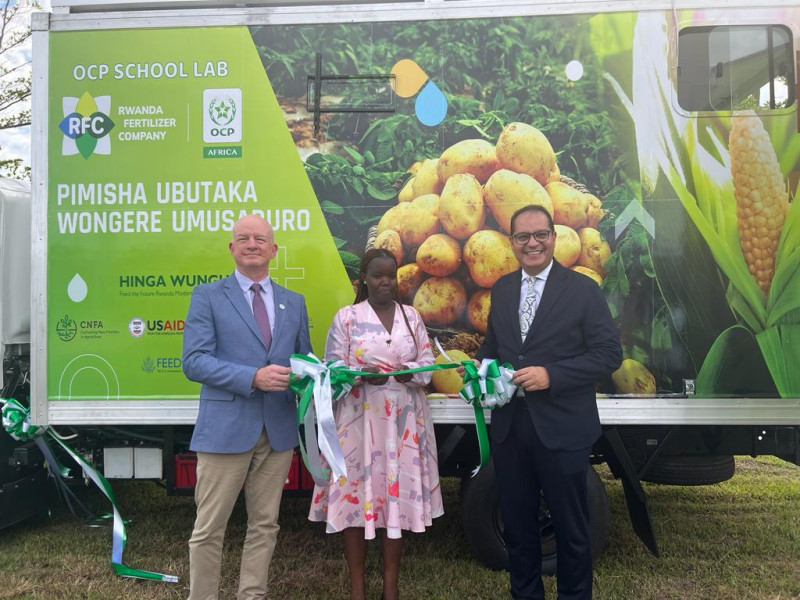
Photo shows Dr Florence Uwamahoro, DDG RAB, Daniel Gies, Chief of Party, CNFA and Dr. Anouar Jamali, CEO OCP Africa
Commenting on the partnership, CEO of OCP Africa Mohammed Anouar Jamali stressed that the agreement is part of a joint effort seeking to tackle challenges farmers face to “ensure yield and income increase.”
Daniel Gies, the chief of party of the USAID-funded Hinga Wunguke activity also emphasized the importance of the partnership, stressing that this approach is part of the innovative initiatives that benefit smallholder farmers “to be able to participate in competitive markets and grow profitable.”
On the same day of the MoU agreement signing, USAID and CNFA, as well as the Rwandan Fertilizer Company, launched an OCP School Lab Project, which was kicked off in a partnership with Rwanda’s Ministry of Agriculture.
“Lead farmers from several districts attended the official launching in Murindi of OCP SCHOOL LAB to experience high technology for fertilizer recommendations based on soil, yield target and crop nutrition,” OCP Africa said.
During the launch, farmers met with professionals and experts in the field, who shared their know-how and expertise to allow farmers to improve their farming experience.
Since its creation in 2016, OCP Africa has stepped up efforts to help support farmers on the continent. The group’s school labels benefited 770,000 farmers in nine African countries including in Nigeria, Togo, Ghana, Guinea, Cote d’Ivoire, Kenya, Burkina Faso, Senegal, and Tanzania.