Cross-sector partnerships can accelerate transformation of African agriculture

Available in

Africa’s agriculture sector holds enormous promise as an engine for economic transformation, yet recent performance falls short of that potential. Despite the continent’s vast arable land and the central role farming plays in millions of livelihoods, agricultural contribution to GDP growth has stagnated. Weather extremes have played a part, but deeper issues — limited investment in climate-resilient infrastructure, inadequate access to drought-tolerant seeds, and underdeveloped water management systems — are major constraints on productivity and resilience.
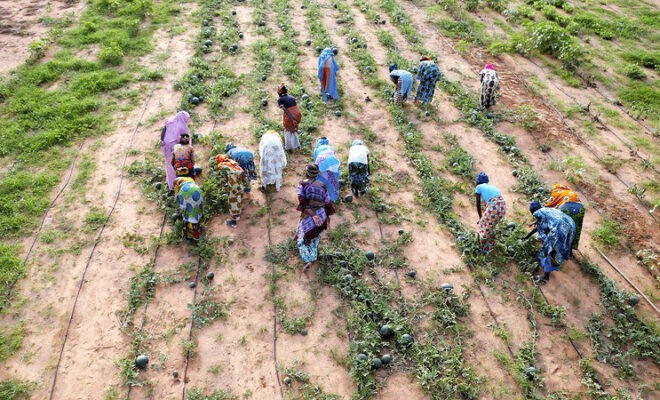
Investment patterns partly explain this underperformance. Much funding has been funneled into food processing and supply-chain activities rather than primary production, and many projects still depend on concessional finance or donor support. High inflation and rising input costs further squeeze margins, making farming a less attractive proposition for private capital. At the same time, policy and project design often overlook the reality that most African production occurs on smallholder plots, not vast commercial estates, and so interventions that ignore this structure miss the people who matter most.
The continent’s food security challenge is striking when set against its natural endowment. Africa holds more than 60 percent of the world’s uncultivated arable land, yet undernourishment has risen in recent years and the region produces only a fraction of global agricultural output. Heavy reliance on food imports drains billions of dollars annually and highlights a mismatch between Africa’s development priorities and the direction of investment flows. Shifting that trajectory requires aligning finance with sustainable agricultural practices, resilient value chains, and inclusive models that serve smallholders and rural communities.

Digital innovation must be central to that shift. Technologies ranging from satellite-derived vegetation indices to mobile-based platforms for financial services can make farming less risky and more profitable. Index insurance products, which pay out based on measurable weather or vegetation metrics rather than individual loss assessments, are particularly promising because they are scalable and lower-cost. When combined with mobile banking, agronomic advisory services and tailored credit, these digital solutions can deliver bundled services to farmers more efficiently than traditional approaches.
Reaching smallholders will demand partnerships across sectors. Telecommunications firms, banks, insurers and fintechs each bring capabilities that, when integrated, can expand access to insurance, credit and extension services in underserved rural areas. Smallholders typically lack collateral and formal credit histories, which limits their access to conventional financial products. Cross-sector collaboration can bridge these gaps by using alternative data sources, digital delivery channels and risk-sharing structures that make products viable for low-margin agricultural markets.
Blended finance and risk-sharing mechanisms will be essential to attract private capital at scale. Public and philanthropic capital can de-risk early-stage interventions, allowing development finance institutions and commercial investors to participate. Such structures can catalyse investment in digital infrastructure, capacity building and product development, enabling data-driven decision-making for farmers and strengthening resilience against climate shocks. Despite their potential, blended instruments remain underutilised in agriculture and must be scaled to meet demand.
Practical examples demonstrate that collaborative models can work. Strategic partnerships that combine private insurers’ market knowledge with concessional funding and technical assistance from multilateral institutions have supported index-based insurance schemes that protect tens of thousands of smallholders and agricultural SMEs. These initiatives show how shared-risk frameworks can open difficult markets, expand coverage, and promote climate-resilient practices while supporting food security objectives.
To seize this moment, four priorities should guide action. First, the private sector must help translate capital into inclusive financial products, designing blended funds and instruments that target women and young farmers. Second, policy and regulatory environments need reform to accelerate the uptake of agri-fintech and insurance innovations, including time-limited sandboxes that allow experimentation. Third, institutional coordination across ministries, regulators and development partners must align mandates and embed measurable financial inclusion metrics into agricultural programmes. Fourth, sustained investment in digital infrastructure and unified data platforms is required to enable real-time claims processing, product design and evidence-based policymaking.
If implemented in a coordinated way, these measures can transform African agriculture from a vulnerability into a source of resilience and growth. The moment calls for cross-sector collaboration that goes beyond isolated projects, mobilising public and private capital, technology and policy reform to create scalable, farmer-centred solutions. With focused effort and the right partnerships, agriculture can become a cornerstone of inclusive economic development across the continent.