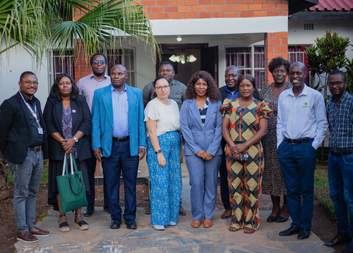

Zambia harnesses behavioural science to drive climate-smart agriculture adoption

Available in

Zambia is strengthening climate resilience and sustainable food systems by integrating behavioural science into climate-smart agriculture training and extension services. Through collaboration between the Sustainable Intensification of Agriculture in Zambia (SIFAZ) and FACE-NDC projects, the initiative is helping smallholder farmers adopt climate-smart technologies and sustainable intensification practices at scale.
The approach, which blends climate education, behaviour insights, and community-led learning, was recently showcased at the 19th FAO Subregional Multi-Disciplinary Team (MDT) Meeting for Southern Africa, highlighting a new frontier in farmer engagement and climate action across the region.
Bridging the gap between knowledge and practice in climate-smart agriculture

Agriculture, forestry and land-use change remain major contributors to greenhouse gas emissions in Zambia, with agricultural expansion and energy-related emissions accelerating climate risks. While farmers are increasingly aware of sustainable practices, adoption remains limited due to social, cultural, and behavioural barriers. Recognizing that technical training alone is not enough, FAO and national partners introduced a behaviour-informed approach to climate education to close the gap between knowledge and sustained practice. By making climate messaging more relatable and grounded in local realities, the initiative supports farmers to change behaviours, adopt climate-smart technologies, and improve land management for long-term resilience.
Community-driven design and behaviour-change tools
Implementation teams drawn from the SIFAZ and FACE-NDC projects — including behavioural scientists, communication specialists, agronomists, and extension officers — engaged farmers, women, youth and traditional leaders through community dialogues and focus group discussions to understand local motivations, barriers and needs. Using a behavioural prioritization framework, the programme identified key behavioural drivers and designed targeted interventions aligned with cultural norms and farming systems. Blended learning approaches combined field demonstrations, participatory problem-solving, peer exchange and feedback loops to build trust and foster commitment. The programme reinforced knowledge transfer through lead-farmer training, mentorship, and reflective learning, positioning communities as co-creators of change.
Strong adoption, improved yields, and empowered farmer networks
The initiative has driven significant uptake of Sustainable Intensification Practices (SIPs). More than 47 600 farmers have been trained through lead-farmer models, resulting in average yield increases of 60 percent and profit gains of 40 percent among participating households. The programme has strengthened trust in extension systems, linking traditional knowledge with modern technologies through farmer-to-farmer learning. Early results demonstrate that behaviour-responsive agricultural extension can accelerate climate-smart technology adoption, enhance productivity and build resilience. Particularly when women and youth are engaged as change agents within their communities.
Scaling behaviour-informed climate action nationwide
With both SIFAZ and FACE-NDC operating nationally, the model is being expanded to additional districts as part of Zambia’s broader climate and agricultural policy efforts. Scaling includes integrating behaviour-change methodologies into extension and training programmes, strengthening digital platforms for knowledge sharing, and building capacity for implementing partners and local authorities. Continued collaboration on monitoring, learning and communication will ensure consistent impact as the approach scales. A detailed implementation framework is guiding expansion across Central, Copperbelt, Eastern, Southern, Western and Northern provinces, with nationwide rollout under way.
By embedding behavioural science in climate education and empowering farmers as leaders of change, Zambia is advancing a new model of climate-smart agriculture — one that strengthens food security, improves livelihoods, and accelerates progress toward sustainable, low-emission agrifood systems.