

FG Advocates Blended Finance Model to Close Nigeria’s N3.4 Trillion Agriculture Financing Gap
Available in

The Federal Government of Nigeria has called for the adoption of blended finance models to bridge the country’s estimated N3.4 trillion agricultural financing gap, as part of efforts to boost productivity, improve yields, and strengthen food security.
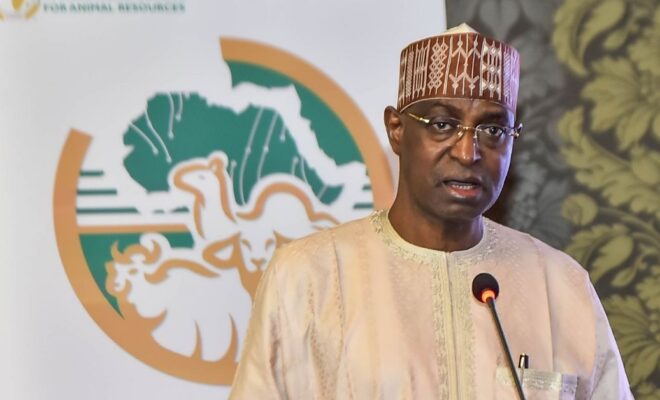
Speaking at the Vanguard Economic Discourse held in Lagos, the Minister of Livestock Development, Idi Maiha, emphasised that food security should be treated not only as an agricultural concern but as a critical pillar of national security and socio-economic stability.
Represented by his Special Adviser, Prof. Eustace Iyayi, the minister noted that the livestock sector contributes between 5% and 8% to Nigeria’s GDP and accounts for nearly one-third of the country’s agricultural GDP. Beyond its economic value, he highlighted the sector’s importance in addressing nutrition challenges, particularly protein deficiency.

Maiha identified access to affordable finance as one of the most significant constraints facing both crop and livestock farmers. He stressed that high interest rates—often between 23% and 25%—make agricultural investment unviable.
“We need financing structures that allow farmers to access credit at single-digit interest rates,” he said. “With less than 5% of commercial bank lending going to agriculture, Nigeria must promote blended finance models, agricultural insurance, credit guarantees, and platforms that attract private sector investment.”
The event, themed “Food Security and Socio-economic Stability: Options for Nigeria’s Agriculture Sector Rebound,” highlighted the urgency of addressing systemic challenges affecting food systems globally and domestically. These include climate variability, geopolitical disruptions, inflationary pressures, and rapid population growth—factors that are further compounded in Nigeria by structural inefficiencies.
Also speaking at the event, the Minister of Agriculture and Food Security, Abubakar Kyari, reinforced the link between food security and socio-economic stability. Represented by his Technical Assistant on Partnerships and Collaboration, Maruf Ajenifuja, Kyari outlined several strategic priorities aimed at revitalising the sector.
These include expanding access to agricultural inputs, reducing input costs for smallholder farmers, improving land management systems, promoting climate-smart agricultural practices, and increasing access to irrigation and mechanisation.
“We are scaling up mechanisation and rolling out targeted interventions to improve farming operations,” he said, referencing the government’s flagship $538 million Special Agro-Industrial Processing Zones (SAPZ) programme, which is designed to boost value addition and private sector participation.
Despite these efforts, Kyari acknowledged a significant mechanisation gap. An estimated 80–90% of Nigerian farmers still rely on manual labour, while about 60% use animal-drawn implements. Only 3–4% of farmers operate fully mechanised, engine-powered systems—limitations that continue to constrain productivity and efficiency.
On financing, he reiterated that the N3.4 trillion gap represents less than 4% of GDP, underscoring the scale of underinvestment in the sector. He added that targeted support for smallholder farmers—particularly through subsidised inputs and financing—can reduce production costs, increase yields, and ultimately lower food inflation.
Providing an international perspective, the Food and Agriculture Organization (FAO) Representative in Nigeria and ECOWAS, Dr. Hussein Gadain, stressed that no agricultural sector can achieve meaningful recovery without improved access to finance.
“Smallholder farmers, pastoralists, and agri-preneurs need affordable credit, insurance, and digital financial services to invest and manage risks,” he said. “Blended finance mechanisms can help mobilise private capital while safeguarding vulnerable groups.”
Gadain also highlighted the importance of strengthening trade- and market-led growth across key value chains, including cocoa, cashew, cassava, and livestock products. He noted that improving infrastructure, logistics, cold chains, and quality standards will be critical to enhancing export competitiveness and reducing import dependence.
In addition, he called for stronger investment in research and development, linking national research institutions, universities, and the private sector to drive innovation in crop varieties, animal genetics, and processing technologies aligned with global standards.


