

Livestock Monitoring Market to Reach USD 18.9 Billion by 2033
Available in

According to Research Intelo, the global livestock monitoring market was valued at USD 6.5 billion in 2024 and is projected to reach USD 18.9 billion by 2033, expanding at a CAGR of 12.5%. This growth is driven by the rapid adoption of precision livestock farming, increasing demand for high-quality animal protein, and a growing emphasis on operational efficiency and animal welfare. Continuous technological advancements and rising investments in smart agriculture solutions are further accelerating market expansion.
What is driving the growing importance of livestock monitoring?
The livestock monitoring market is gaining momentum due to the increasing need for efficient farm management and improved animal productivity. Precision livestock farming enables data-driven decision-making, allowing producers to optimize feeding, breeding, and disease management practices. Additionally, rising concerns regarding food safety, traceability, and sustainability are encouraging the adoption of advanced monitoring technologies across both developed and emerging economies.

What technologies define the livestock monitoring ecosystem?
Livestock monitoring systems integrate multiple advanced technologies to track animal health, behavior, and environmental conditions:
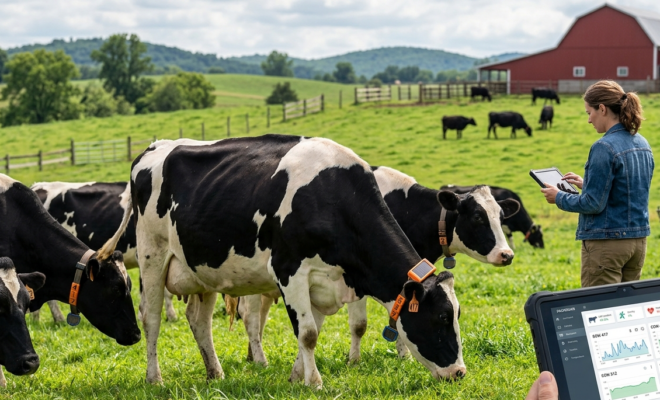
- IoT-enabled sensors and wearable devices for real-time tracking of movement, temperature, and vital signs.
- RFID tags and GPS systems for identification and location tracking.
- Automated milking systems to enhance dairy farm efficiency.
- AI-driven analytics platforms for predictive health insights and behavioral analysis.
- Cloud-based farm management software for centralized data access and decision-making.
- Together, these technologies create a connected ecosystem that improves operational visibility, reduces manual intervention, and enhances farm productivity.
Which factors are accelerating market growth?
1. Rising Adoption of IoT and Sensor-based Monitoring:
The increasing deployment of IoT-enabled sensors and smart devices allows continuous tracking of livestock health and productivity. These solutions enable early disease detection, improve animal welfare, and optimize resource utilization, making them essential tools for modern livestock operations.
2. Rapid Technological Advancements and Automation:
Innovations in artificial intelligence, big data analytics, and cloud computing have transformed livestock management. Automated systems now provide real-time insights into feeding patterns, reproductive cycles, and environmental conditions, enabling proactive decision-making while reducing labor dependency and operational inefficiencies.
3. Growing Demand for High-Quality Animal Protein:
Rising global population and changing dietary preferences are driving demand for meat and dairy products. This has increased the need for efficient, traceable, and sustainable livestock production systems, pushing farmers toward advanced monitoring solutions.
4. Supportive Government Policies and Incentives:
Governments and international organizations are promoting digital agriculture through subsidies, grants, and regulatory frameworks focused on animal traceability, disease control, and sustainability. These initiatives are encouraging wider adoption of livestock monitoring technologies.
What challenges are limiting widespread adoption?
Despite strong growth prospects, several challenges continue to hinder market penetration:
- High initial investment costs, particularly for small and medium-scale farms
- Lack of standardization in data interoperability and system integration
- Connectivity limitations in rural and remote areas
- Volatility in component costs, including sensors and electronic devices
Regulatory complexities related to data privacy, animal welfare, and environmental compliance
Addressing these barriers will be critical to ensuring broader and more inclusive adoption.
How is the market segmented?
The livestock monitoring market can be broadly segmented based on component, application, livestock type, and geography:
- By Component: Hardware (sensors, tags, GPS devices), software (analytics platforms), and services
- By Application: Health monitoring, feeding management, reproduction tracking, and behavior monitoring
- By Livestock Type: Cattle, poultry, swine, and others (sheep, goats)
- By Geography: North America, Europe, Asia Pacific, Latin America, and the Middle East & Africa
Cattle monitoring holds the largest share, driven by the high economic value and management complexity associated with dairy and beef production.
What role does data analytics play in livestock monitoring?
Data analytics forms the backbone of modern livestock monitoring systems. By leveraging real-time and historical data, stakeholders can:
- Detect early signs of disease outbreaks
- Optimize feed efficiency and reduce waste
- Improve breeding performance and reproductive cycles
- Enhance overall herd productivity and profitability
The integration of artificial intelligence further strengthens predictive capabilities, enabling a shift from reactive to proactive livestock management.
Which regions are leading the adoption?
- North America (Market Leader – ~36% Share in 2024)
North America dominates the global market due to its advanced agricultural infrastructure, high adoption of precision farming technologies, and strong regulatory support. The US leads in deploying AI-powered and sensor-based livestock monitoring systems. - Asia Pacific (Fastest-Growing Region – CAGR ~15.2%)
Asia Pacific is emerging as the fastest-growing market, driven by increasing investments in agricultural modernization, rising awareness of animal health, and expanding commercial livestock sectors in countries such as China, India, and Australia. - Latin America, the Middle East, and Africa (Emerging Markets)
These regions are gradually adopting livestock monitoring technologies, supported by growing demand for productivity improvement and disease management. However, challenges such as limited infrastructure and lower technology penetration continue to restrict rapid adoption.
What trends are shaping the future of the market?
Key trends transforming the livestock monitoring market include:
- Integration of AI and machine learning for predictive health management
- Expansion of wearable technology for continuous livestock tracking
- Adoption of blockchain technology for enhanced traceability and transparency
- Development of cost-effective solutions for smallholder farmers
- Increasing focus on sustainability, including emissions reduction and efficient resource utilization
These trends are redefining how livestock operations are managed globally.
What is the future outlook for the livestock monitoring market?
The livestock monitoring market is poised for significant growth, transitioning from a value-added solution to a critical component of modern farming. The projected increase from USD 6.5 billion in 2024 to USD 189 billion by 2033 highlights its expanding role in ensuring efficient, sustainable, and data-driven livestock production. As technologies become more accessible and scalable, adoption is expected to extend across farms of all sizes. Continuous innovation, combined with supportive policies and infrastructure development, will shape the next phase of market evolution.
By: Mandar Shewale
Source: https://researchintelo.com/report/livestock-monitoring-market