
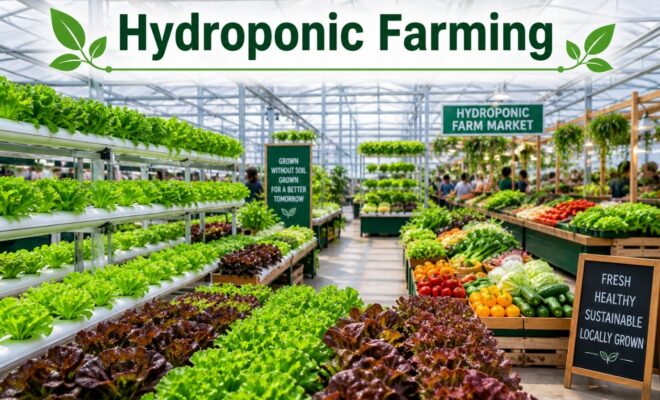
Hydroponic Farming Market To Reach USD 42.7 billion by 2033
Available in

Market Summary
According to our Growth Market Report, the global hydroponic farming market size reached USD 13.2 billion in 2024, demonstrating a robust trajectory driven by technological innovation and growing demand for sustainable agriculture. The market is expected to expand at a CAGR of 13.8% during the forecast period, with the market size projected to reach USD 42.7 billion by 2033. This impressive growth is primarily attributed to the increasing adoption of controlled environment agriculture, the need for higher crop yields, and the rising awareness of water conservation in farming practices.
Introduction: Farming Without Soil, Growing Beyond Limits

Africa stands at a critical agricultural crossroads. With rapid urbanization, climate variability, and pressure on arable land, traditional farming alone cannot meet future food demands. Hydroponic farming—growing plants without soil using nutrient-rich water—emerges not just as an alternative, but as a transformative solution.
The hydroponic farming market in Africa is gaining momentum, driven by innovation, necessity, and the continent’s ambition to secure sustainable food systems.
What is Hydroponic Farming? A Simple Yet Powerful Concept
Hydroponics replaces soil with controlled nutrient solutions, allowing plants to grow faster and more efficiently. By managing water, nutrients, and environmental conditions precisely, farmers can achieve higher yields in smaller spaces.
Key advantages include:
- Up to 90% less water usage compared to traditional farming
- Faster crop cycles and year-round production
- Minimal land requirement—ideal for urban environments
- Reduced dependency on unpredictable weather
Market Overview: A High-Growth Opportunity
The hydroponic farming market in Africa is still in its early stages but shows strong growth potential. Increasing investment from agritech startups, NGOs, and government programs is accelerating adoption across regions.
Key Market Drivers
- Water Scarcity and Climate Change
Many African countries face irregular rainfall and prolonged droughts. Hydroponics offers a controlled system that uses significantly less water, making it ideal for arid and semi-arid regions. - Urban Food Demand
Rapid urbanization is increasing the demand for fresh, locally grown produce. Hydroponic farms can be established in cities, reducing reliance on long supply chains. - Youth Engagement in Agriculture
Hydroponics is attracting young entrepreneurs due to its modern, tech-driven approach. It transforms agriculture into a profitable and innovative career path. - Export Potential
High-value crops such as lettuce, herbs, strawberries, and tomatoes grown hydroponically meet international quality standards, opening export opportunities.
Technology Trends Shaping the Market
Hydroponics in Africa is evolving with the integration of modern technologies:
Smart Farming Systems
IoT-based monitoring allows farmers to track nutrient levels, pH, and temperature in real time.
Solar-Powered Hydroponics
Given Africa’s abundant sunlight, solar energy is being used to power hydroponic systems, reducing operational costs.
Modular and Low-Cost Systems
Innovations in affordable hydroponic kits are making the technology accessible to smallholder farmers.
Challenges: Barriers to Overcome
Despite its promise, the hydroponic farming market faces several challenges:
- High Initial Investment: Setup costs can be a barrier for small-scale farmers
- Technical Knowledge Gap: Requires training and skill development
- Limited Awareness: Many farmers are still unfamiliar with hydroponic techniques
- Supply Chain Constraints: Access to equipment and nutrients can be inconsistent
Addressing these challenges will be critical to scaling adoption across the continent.
Opportunities: A Market Ready to Expand
The future of hydroponic farming in Africa is filled with opportunities:
- Development of localized hydroponic solutions tailored to African conditions
- Expansion of training and education programs
- Public-private partnerships to subsidize initial costs
- Integration with vertical farming for urban agriculture
- Growth of agritech startups focused on sustainable farming
Impact on Food Security and Sustainability
Hydroponic farming has the potential to significantly improve food security in Africa by:
- Enabling consistent crop production regardless of climate
- Reducing dependence on imports
- Minimizing post-harvest losses through local production
- Supporting sustainable water usage
It also contributes to environmental conservation by reducing soil degradation and limiting chemical runoff.
Future Outlook: From Innovation to Mainstream Adoption
According to our Growth Market Report, The hydroponic farming market in Africa is expected to transition from niche innovation to mainstream agricultural practice over the next decade. As costs decrease and awareness increases, adoption will expand beyond urban centers into rural and peri-urban areas.
Governments, investors, and entrepreneurs who recognize this shift early will play a key role in shaping Africa’s agricultural future