

SADC Emerges as Africa’s Top Agricultural Performer in New CAADP Review
Available in

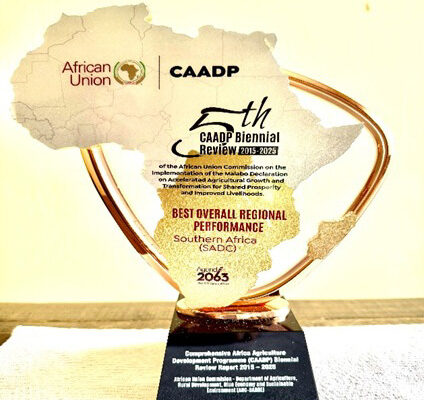
Southern African Development Community has emerged as Africa’s leading regional bloc in agricultural transformation after recording the continent’s highest performance score in the newly released 5th Comprehensive Africa Agriculture Development Programme (CAADP) Biennial Review Report.
The report, launched by the African Union Commission’s Department of Agriculture, Rural Development, Blue Economy and Sustainable Environment on May 14, marks the conclusion of the Malabo Declaration implementation period covering 2015 to 2025 and sets the stage for the new CAADP Kampala Declaration and Strategy and Action Plan for 2026–2035.
SADC achieved a regional score of 5.77 out of 10, placing Southern Africa ahead of all Regional Economic Communities across the continent and reinforcing the region’s growing influence in shaping Africa’s agricultural development agenda.

The strong performance reflects years of coordinated regional planning, technical support and policy implementation aimed at improving food security, agricultural productivity and resilience across member states.
Several SADC countries delivered particularly strong performances, with Malawi, Mauritius, Tanzania and Zimbabwe all scoring above the continental benchmark of five out of ten.
Lesotho and Zimbabwe also received special recognition for demonstrating continuous improvement across multiple Biennial Review cycles, signalling stronger institutional systems and policy execution capacity.
Regional officials attributed the achievement largely to coordinated technical support mechanisms led by the SADC Food, Agriculture and Natural Resources Directorate, alongside stronger collaboration between policymakers, agricultural experts and member states.
The Biennial Review process has become one of Africa’s key accountability tools for tracking progress in agricultural development, measuring performance across indicators such as agricultural growth, food security, trade expansion, public investment and nutrition outcomes.
During the official launch, Moses Vilakati praised Southern Africa’s commitment to advancing the CAADP agenda while also acknowledging the support provided by partners including Alliance for a Green Revolution in Africa, the Food and Agriculture Organization and AUDA-NEPAD.
The latest report arrives at a critical moment for Africa’s agriculture sector as governments confront mounting pressures linked to climate change, rising food insecurity, economic shocks and unemployment.
The transition from the Malabo Declaration to the Kampala Declaration framework is expected to place stronger emphasis on resilient agri-food systems, regional value chains, sustainable production and private-sector participation.
SADC’s performance is increasingly being viewed as evidence that stronger regional coordination, evidence-based planning and collective implementation strategies can accelerate agricultural transformation across Africa.
As African governments move into the next decade of CAADP implementation, Southern Africa’s experience may provide a blueprint for how regional cooperation can strengthen food systems, improve agricultural competitiveness and support inclusive economic growth across the continent.


