
Egypt Launches Solar-Powered Desert Farming Project to Boost Food Security and Climate Resilience
Available in

A new renewable energy-powered agriculture project in Egypt is demonstrating how agrivoltaics could transform food production in arid regions while improving climate resilience and water efficiency.
The initiative, launched through a partnership between 3E, ORG, Engazaat Development Foundation, Habiba Community and the Alexandria University Center of Excellence for Water, combines solar energy, sustainable agriculture and community-led development to create a scalable desert farming model for water-scarce environments.
Agrivoltaics Offers New Hope for Desert Agriculture

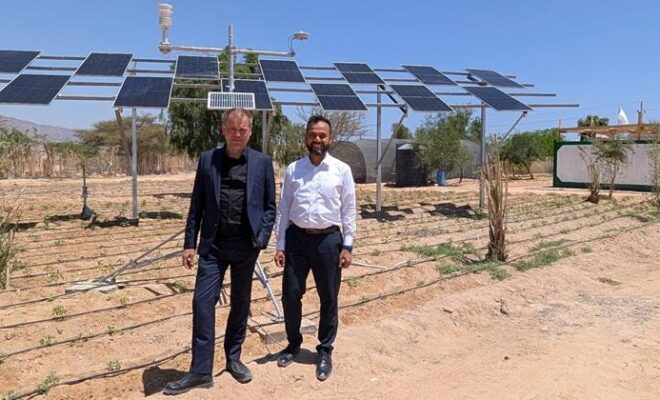
The project is based in South Sinai, Egypt, where solar photovoltaic (PV) panels are being installed directly above agricultural crops in an agrivoltaics system designed to support farming in extreme desert conditions.
By providing partial shade, the solar panels help reduce heat stress on crops and minimise water evaporation, two major challenges facing agriculture in arid climates. At the same time, the system generates clean renewable electricity for nearby communities.
The pilot phase currently includes a 6 kWp agrivoltaics installation used for research and demonstration purposes. A larger 100 kWp solar-powered agriculture project is also under development in Al Moghra, Marsa Matrouh, to assess the scalability of the model across Egypt’s desert regions.
Renewable Energy and Smart Agriculture Integration
Renewable energy company 3E is leading the engineering and technical design of the agrivoltaics infrastructure through its research and development teams.
The company is also integrating the project with its SynaptiQ renewable energy analytics platform, which will monitor environmental conditions, solar energy generation and agricultural performance over time.
The initiative is expected to provide valuable data on how agrivoltaics can improve crop productivity, optimise water use and strengthen climate adaptation strategies in desert environments.
Focus on Climate Resilience and Sustainable Food Production
According to the project partners, the initiative focuses on five strategic areas:
- Agrivoltaics development
- Climate change mitigation
- Agricultural adaptation
- Community resilience
- Environmental monitoring
The partners believe integrated renewable energy and agriculture systems could play a key role in restoring degraded land, improving food security and supporting sustainable rural livelihoods across Africa and the Middle East.
Gofran Chowdhury, Head of Innovation at 3E, said the project aims to bring advanced renewable energy solutions to communities that are often excluded from technological development.
“At 3E, we believe in a world powered by renewable energy. Yet too often, the communities that could benefit the most remain beyond the reach of innovation and support,” Chowdhury said.
“Through the support of the Government of Flanders, Belgium and strong collaboration with research partners, we have been able to bring state-of-the-art solar design and digital solutions to a nomadic community in South Sinai.”
Scalable Model for Africa’s Dry Regions
As construction and environmental monitoring continue, the project partners hope the initiative can become a scalable model for climate-smart agriculture in arid regions across Africa.
With rising temperatures, water scarcity and growing food security concerns affecting many African countries, agrivoltaics is increasingly being viewed as a practical solution that combines renewable energy generation with sustainable agricultural production.
The Egypt project highlights how solar-powered farming systems could help communities adapt to climate change while improving energy access, conserving water resources and increasing agricultural productivity in some of the world’s harshest environments.