
African Development Bank Launches $87 Million Project to Strengthen Sudan’s Agriculture Sector
Available in

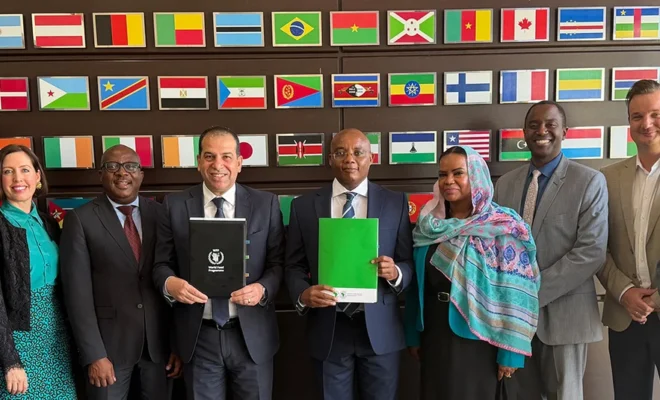
BOOST project launch signing ceremony group photo with Bank Group and WFP colleagues including AfDB East Africa Director General Alex Mubiru (far left), WFP Sudan Country Director, Abdallah Alwardat (4thfrom L) and David Muthusi Mutuku, AfDB Sudan Country Manager (5th from L).
SUDAN – The African Development Bank Group (AfDB) and the United Nations World Food Programme (WFP) have launched an $87 million initiative aimed at revitalising Sudan’s agricultural sector and strengthening food security amid the country’s ongoing humanitarian crisis.
The four-year programme, known as the Boosting Agrifood Systems Resilience in Sudan (BOOST) Project, seeks to support farming communities, restore agricultural production and improve the resilience of food systems in key crop-producing regions.

The project was officially launched on 22 May during a signing ceremony at the African Development Bank’s East Africa Regional Office in Nairobi.
Supporting Food Production Amid Crisis
Sudan is currently facing one of the world’s most severe food security challenges, with more than 19 million people experiencing crisis levels of hunger or worse.
BOOST will focus on the rain-fed agricultural areas of Sennar State and Blue Nile State, regions that have traditionally served as important food production hubs but have seen productivity decline due to conflict, displacement and limited access to agricultural inputs.
The initiative aims to help farmers restore production, reduce post-harvest losses, improve incomes and strengthen market access.
“Investing in Sudan’s farmers is investing in the country’s recovery and long-term resilience,” said David Muthusi Mutuku, AfDB Country Manager for Sudan.
According to Mutuku, the programme will support practical agricultural solutions capable of increasing staple food production, revitalising rural economies and helping communities withstand future shocks.
Reaching More Than 230,000 Farming Households
The project is expected to directly support more than 230,000 farming households over its four-year implementation period.
Partners estimate that participating farmers could produce nearly one million metric tonnes of cereals and pulses, enough to meet the annual cereal consumption needs of almost nine million people and pulse requirements for more than 15 million people.
In addition to boosting crop production, the programme will organise farmer groups, provide agricultural training and promote agribusiness development opportunities.
Building on Existing Successes
The BOOST initiative builds on lessons learned from the ongoing Sudan Emergency Wheat Production Project, which is also being implemented by WFP with support from the African Development Bank.
WFP Sudan Country Director Abdallah Alwardat noted that farmers participating in resilience-building programmes have demonstrated remarkable adaptability despite the conflict.
“Farmers who already work with WFP in our resilience activities told me they did not require food assistance even during the war,” Alwardat said. “Many have managed to preserve their agricultural operations and improve yields of key crops such as wheat and sorghum.”
Expanding Agricultural Resilience
The project will be implemented by WFP under the African Development Bank’s third-party implementation framework, working alongside United Nations agencies and agricultural research institutions.
Since 2023, the African Development Bank and WFP have partnered on resilience-building initiatives in Sudan worth nearly $267 million, reflecting growing efforts to shift support from emergency food aid toward strengthening local food production systems.
The BOOST project is expected to play a critical role in improving agricultural productivity, enhancing rural livelihoods and supporting Sudan’s long-term recovery through sustainable food production.