
Which Is Better: Petrol Or Battery? That’s The Wrong Question
Available in

Why The Best Landscaping Fleets Need Both
What if the entire petrol-versus-battery debate in outdoor power equipment is asking the wrong question? Instead of asking which is better, perhaps the smarter question is: which power source is better suited to which job?
Just ask Brendan Burgess, owner of Burgess Landscapes. With a workforce of between 200 and 250 people servicing municipal and industrial properties, prominent hotel groups and residential estates, he knows equipment decisions directly affect productivity and the bottom line.

Today, approximately 75% of his company’s equipment is battery-powered. However, the higher upfront cost, particularly when chargers and additional batteries were factored in, was a major consideration.
“It was a tough decision,” says Burgess, “but once we sat down and did the calculations, the picture changed. With the amount of work our machines do, battery equipment effectively pays for itself within two years. The more you use it, the quicker you recover your investment. With petrol machines, you will always be spending money on fuel.”
That doesn’t mean he’s ready to say goodbye to petrol. Far from it.
For Burgess, equipment choice starts with the site’s demands, and some jobs still call for petrol. Tackling an overgrown plot, for example, may require larger machines for which battery-powered alternatives remain limited. Similarly, clearing a six- to eight-kilometre fence line in difficult terrain makes petrol the more practical option. Carrying 10 to 12 batteries to keep a brushcutter and blower running would simply be too heavy, whereas carrying a tank of fuel is manageable.
At the other end of the spectrum are sites where noise is a major consideration. “Every client we’ve dealt with prefers battery equipment, but particularly the hotels,” he notes. “Immaculate grounds mean little if guests are disturbed while the work is being done. Quiet machines remove that problem, and that has been a factor in our winning major hotel contracts.”
“We’re also not restricted to only working at specific times, which increases productivity as we can get more done in less time, often with fewer machines,” he adds. “Several hotels also see battery equipment as a sustainability selling point, with low noise, no fuel on site and no exhaust emissions.”
Of course, with their machines generally running for six or seven hours a day, operating costs and downtime are equally important considerations.
The cost of fuel is a major pressure point. “Price increases, particularly in recent months, hurt bitterly,” says Burgess, “whereas battery costs are more of a constant. Electricity increases are predictable, and teams can charge equipment at a client’s premises with permission.”
Maintenance is the next big difference. Burgess budgets about 30% of a petrol machine’s cost for maintenance each year, versus less than 10% for battery, which needs servicing far less often.
Downtime is a factor too. “A petrol brushcutter could realistically be down for one to three days, and a machine sitting idle in a workshop is costing money,” he notes.
“That’s why we look beyond the purchase price when assessing the value of a machine.”
For Burgess, lawnmowers, leaf blowers and brushcutters are among the strongest cases for battery power. Lawnmowers use hardly any battery power, while the quieter operation of blowers and brushcutters makes it a no-brainer. But when it comes to heavier jobs, larger petrol-powered machines remain indispensable.
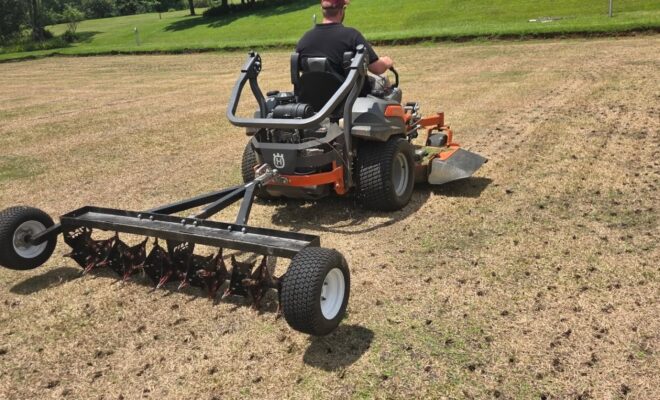
Asked about a favourite Husqvarna machine, Burgess names the petrol-powered Z560 ride-on mower. He describes it as “absolutely phenomenal” as it’s removed a lot of operational headaches. What he values most, though, is its reliability and minimal downtime.
His advice to professionals in the industry considering their next equipment investment is to seriously consider battery, but to do their research and planning first. “Make sure you’re choosing the right machine for the right application. You have to compare like for like and application with application,” he emphasises. “That is the number one thing I see people get wrong.”
Ultimately, building a productive fleet isn’t about committing to one technology at the expense of another. Burgess sums it up like this: “Battery is powerful, efficient and can make excellent financial sense, but there will always be a place for fuel as well. That will never go away. It’s about knowing when each will give you the best result.”