From Farm to Factory: How Nestlé Nigeria Is Investing in Farmers and Food Security
Available in

For many smallholder farmers in Nigeria, producing a good harvest is only half the battle. Finding reliable buyers, securing competitive prices, managing rising production costs and accessing modern agricultural services remain major challenges.
For dairy farmers, the difficulties are even greater. Low milk yields, inadequate animal feed, limited veterinary services and insufficient milk collection and storage infrastructure continue to constrain domestic dairy production.
These challenges affect not only farmers’ livelihoods but also the ability of Nigeria’s food manufacturing industry to source sufficient raw materials locally.

Against this backdrop, Nestlé Nigeria Plc is expanding its involvement in agricultural development through investments in smallholder farmers, dairy production, grain cultivation and regenerative agriculture.
Through partnerships with farmers, government institutions and development organisations, the company is working to strengthen local agricultural supply chains while improving the productivity and market participation of farming communities.
The initiatives include dairy cooperatives, farmer training, demonstration farms, grain aggregation, milk collection infrastructure and programmes designed to connect smallholder farmers with structured markets.
The scale of these interventions is reflected in figures reported by the company and its development partners. Since 2019, Nestlé Nigeria says it has invested more than ₦1.8 billion in dairy development, supporting over 3,000 milk producers and establishing more than 83 dairy cooperatives.
Its grain development programme, Strengthening Farmers’ and SMEs’ Resilience through Climate-Smart Grain Production and Accessing Structured Markets (StreFaS), had engaged 12,373 farmers, with young people accounting for 40 per cent of participants.
Beyond the investment figures, the bigger question is whether these interventions can deliver lasting improvements in agricultural productivity, farmer incomes and domestic food production.
Strengthening Nigeria’s Domestic Dairy Industry
One of Nestlé Nigeria’s most significant agricultural interventions focuses on improving local milk production and strengthening the livelihoods of pastoralist communities.
In February 2025, the company announced that it had invested more than ₦1.8 billion in dairy development since 2019.
The initiative has concentrated on communities around Paikon Kore in the Federal Capital Territory and the Kachia grazing reserve in Kaduna State.
Its interventions include establishing dairy cooperatives, training pastoralists, improving animal health and investing in infrastructure for milk collection, handling and preservation.
According to figures released by Nestlé and subsequently reported by the Federal Ministry of Livestock Development, the programme has established more than 83 dairy cooperatives, supported over 3,000 milk producers and aggregated more than one million litres of raw milk.
More than 2,000 pastoralists have reportedly received training, while over 36,000 cattle have been vaccinated. Infrastructure investments have also included boreholes, water troughs, milk collection facilities and cooling systems.
These interventions address some of the practical constraints affecting dairy production. Reliable water supplies, improved animal health services and appropriate milk-handling infrastructure are essential for increasing productivity and maintaining milk quality.
The company reported that daily milk collection at its collection and cooling centre increased from approximately 200 litres in June 2021 to an average of 6,000 litres.
It also reported that participating milk producers’ monthly household incomes increased from approximately ₦70,000 in 2021 to ₦250,000 in 2024.
While these figures indicate substantial nominal income growth, the actual improvement in household purchasing power would need to account for inflation, feed expenses and other production costs. They also do not establish that all participating households experienced similar gains.
Nevertheless, increased milk collection demonstrates the potential of organised production systems and stronger market connections to improve opportunities for pastoralist communities.
For Nigeria’s food manufacturing sector, stronger domestic dairy production could also create opportunities across the agricultural value chain, including livestock farming, animal feed production, veterinary services and milk processing.
Demonstration Farms and Skills Development to Improve Milk Production
In 2025, Nestlé Nigeria launched a dairy demonstration farm at Paikon Kore to showcase how improved breeding, feeding, animal health and herd management could increase the productivity of local cattle.
The facility builds on the company’s Nestlé Nigeria Livestock Development Project, inaugurated in 2021, with support from the Federal Capital Territory Administration. CBI Innovations Limited and 2Scale have also participated in the programme.
Nestlé said the demonstration farm aims to show how daily milk production from local cattle breeds, which it described as averaging approximately one litre per cow under traditional systems, could potentially increase to more than 10 litres through improved management and breeding.
This is a potential productivity target rather than a verified average achieved across participating farms.
The initiative is intended to provide pastoralists with practical exposure to improved livestock management techniques and demonstrate the potential benefits of adopting better production practices.
The programme received further institutional support in April 2026, when the Federal Government and Nestlé Nigeria signed a memorandum of understanding to establish a Dairy Technical Skills Development Centre in the Federal Capital Territory.
The Federal Ministry of Livestock Development identified the proposed centre as an important intervention in addressing technical skills gaps within Nigeria’s dairy industry.
At the signing, Minister of Livestock Development, Idi Mukhtar Maiha, said traditional pastoral systems generally produced between one and two litres of milk per cow daily. He highlighted inadequate animal husbandry, poor feed formulation, insufficient clean water and limited technical expertise as major constraints.
The minister also estimated Nigeria’s annual dairy import bill at approximately $1.5 billion.
The proposed centre is expected to provide practical training in breeding, calf management, farm operations, record-keeping, milking techniques, milk hygiene, animal welfare, feed management and processing.
According to the government, 70 per cent of the training curriculum will focus on practical farm experience, with the remaining 30 per cent dedicated to classroom instruction.
The centre is planned for the Nestlé Dairy Demonstration Farm at Paikon Kore.
Its long-term value will depend on the number of people trained, the quality of instruction and the extent to which graduates apply their skills to improve livestock productivity and their earnings.
Reaching More Farmers Through Climate-Smart Grain Production
Beyond dairy farming, Nestlé Nigeria is also investing in grain production, with a focus on improving agricultural productivity, promoting regenerative farming practices and connecting smallholder farmers to organised markets.
A key component of this strategy is StreFaS, a three-year programme funded by Nestlé and the Alliance for a Green Revolution in Africa (AGRA), and implemented in partnership with TechnoServe.
Although publicly launched in May 2025, the programme’s implementation period runs from June 2024 to October 2027.
It targets 25,000 smallholder farmers and agricultural aggregators across Kaduna and Nasarawa states, focusing on maize, soybean, rice and sorghum.
The programme combines farmer training in regenerative agriculture with demonstration farms, agricultural enterprise support and connections to formal buyers.
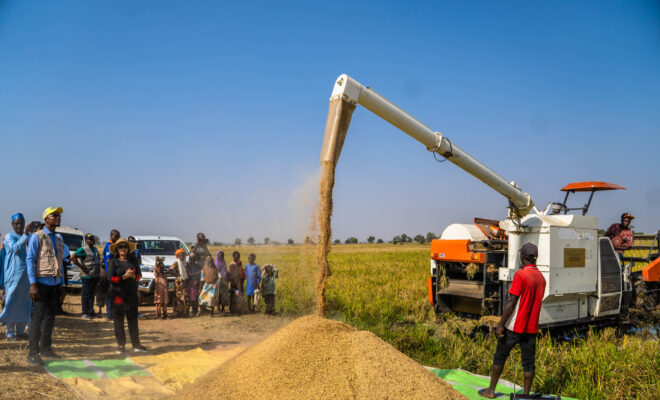
According to figures published by TechnoServe, StreFaS had engaged 12,373 farmers, established 270 demonstration farms and supported the adoption of regenerative agricultural practices across 1,853 hectares.
The programme had also aggregated 74,223.53 metric tonnes of produce from smallholder farmers, with young people representing 40 per cent of those engaged.
These figures demonstrate the programme’s reach and the volume of agricultural produce handled. However, the quantity aggregated should not automatically be interpreted as additional production generated by the initiative.
Aggregation nevertheless plays an important role in agricultural market development. Individual smallholder farmers often struggle to meet the volume, quality and consistency requirements of large commercial buyers.
By bringing produce from multiple farmers together, agricultural aggregators can help smallholders access more structured markets and improve their participation in commercial supply chains.
The actual benefits depend on transparent purchasing arrangements, competitive prices, timely payments and reliable market access.
Promoting Regenerative Agriculture and Local Soybean Production
Another important part of Nestlé Nigeria’s agricultural strategy is its focus on regenerative agriculture, particularly in soybean production.
In October 2025, the company’s MAGGI brand announced the completion of a regenerative agriculture pilot focused on locally sourced soybeans.
The project began in 2023 with an investment exceeding ₦100 million and supported 1,030 soybean farmers.
It was implemented in partnership with TechnoServe and the Sustainable Trade Initiative (IDH), with technical guidance from the Centre for No-Till Agriculture in Ghana.
Participating farmers were introduced to practices such as cover cropping, reduced tillage, crop rotation and hedgerows.
These approaches are designed to improve soil health, reduce erosion, support water retention and strengthen agricultural resilience against changing weather conditions.
Nestlé reported improvements in yields and soil health, adding that the experience from the pilot informed its broader ambition to reach 25,000 smallholder farmers.
The company also highlighted the experience of participating farmer Lawan Abdul, who said his yields had doubled after adopting the recommended farming practices.
While this account illustrates the potential benefits of regenerative agriculture, independently establishing the scale of improvement would require verification of previous and current yields, production costs and the period over which the increase occurred.
Higher yields do not automatically translate into higher profits if production costs increase or market prices decline.
Nevertheless, the pilot demonstrates how food manufacturers can use their demand for agricultural raw materials to encourage more sustainable farming practices.
Soybeans are an important ingredient in food and animal feed value chains. Improving the availability and quality of locally produced soybeans can create opportunities for farmers while helping manufacturers develop more reliable domestic sourcing arrangements.
Nestlé has also stated its ambition to source between 20 and 30 per cent of key ingredients through regenerative agriculture by 2030.
The wider programme targets at least 80,000 metric tonnes of quality grains annually. These are stated ambitions rather than volumes already confirmed as achieved.
Partnerships Connecting Farmers to Markets
Nestlé Nigeria’s agricultural programmes involve several development partners and government institutions, each contributing different forms of expertise and support.
AGRA supports agricultural development, TechnoServe contributes to enterprise and market development, while IDH supports sustainable supply-chain initiatives.
CBI Innovations Limited and 2Scale have also been involved in the company’s dairy development activities.
These partnerships reflect the growing recognition that agricultural transformation requires more than occasional farmer training or the distribution of inputs.
Farmers need access to appropriate production technologies, technical services, reliable buyers, financing and organised markets.
Nestlé contributes its demand for agricultural raw materials and its interest in developing a more dependable local supply base.
When effectively structured, these relationships can benefit both farmers and manufacturers. Farmers gain opportunities to participate in more organised markets, while food processors can improve the consistency and availability of locally produced ingredients.
The company’s involvement in soybean, maize, rice and sorghum production, alongside its dairy development programme, illustrates the connection between agricultural development and food manufacturing.
However, the economic impact of these investments should be measured through transparent procurement, production and income data.
The available programme figures do not establish the total value of agricultural purchases from participating farmers, the proportion of Nestlé Nigeria’s raw materials sourced domestically or the amount of imports displaced through these interventions.
Such information would provide a clearer picture of the relationship between private-sector agricultural investment and the wider Nigerian economy.
Creating Opportunities for Young Farmers
Youth participation is another important dimension of Nestlé Nigeria’s grain development programme.
According to TechnoServe, young people accounted for 40 per cent of the 12,373 farmers engaged through StreFaS.
Their participation is significant in a sector where access to land, finance, technical knowledge and organised markets can influence whether agriculture becomes a viable business opportunity.
Through demonstration farms, technical training and support for agricultural aggregators, the programme seeks to improve the capacity of participating farmers and agricultural enterprises.
However, the long-term impact will need to be assessed through evidence of improved earnings, business growth, farm expansion and sustained participation in commercial agriculture.
Greater transparency around women’s participation and the economic benefits received by different groups of farmers would also help provide a more complete picture of the programme’s impact.
What Does This Mean for Nigeria’s Food Security?
Nigeria’s food security challenges extend beyond agricultural production.
High input costs, inadequate storage, limited mechanisation, unpredictable weather conditions and inefficient market systems continue to affect the performance of agricultural value chains.
Nestlé Nigeria’s agricultural investments address some of these constraints through livestock development, grain aggregation, regenerative farming and technical skills development.
However, the contribution of these interventions to national food security cannot be determined solely by the number of farmers trained or the volume of produce aggregated.
It also requires evidence of additional agricultural production, reduced post-harvest losses, sustained improvements in farmer incomes and increased availability of locally produced food and industrial raw materials.
For the dairy sector, relevant indicators would include the volume of locally produced milk entering the market, the competitiveness of domestic production and the extent to which local supply can meet processing requirements.
For grain production, the focus should extend to productivity gains, farmer profitability, market participation and the sustainability of improved farming practices.
These distinctions are important because the ultimate objective of agricultural investment is not simply to deliver projects but to build productive systems that continue benefiting farmers and businesses over time.
From Agricultural Investment to Lasting Impact
Nestlé Nigeria’s agricultural programmes illustrate how food manufacturers can extend their involvement beyond factory operations into the farming systems that supply their raw materials.
The company’s reported investments span dairy cooperatives, livestock health, milk collection infrastructure, technical training, grain aggregation, soybean production and regenerative agriculture.
The reported figures are significant: more than ₦1.8 billion invested in dairy development since 2019, over 83 dairy cooperatives established, more than 3,000 milk producers supported and over one million litres of raw milk aggregated.
Through StreFaS, its partners have reported engaging 12,373 farmers, establishing 270 demonstration farms and aggregating more than 74,000 metric tonnes of produce.
The soybean pilot also involved an investment exceeding ₦100 million and supported 1,030 farmers.
These figures demonstrate the scale of the interventions. However, their long-term significance will depend on whether they translate into sustainable improvements in agricultural productivity, commercial viability and farmers’ livelihoods.
That means farmers being able to maintain productive soils, manage livestock effectively, access technical services, finance their operations and sell their produce through reliable markets.
It also requires transparent reporting of production, procurement and income outcomes to establish the wider economic and social impact of private-sector agricultural investment.
For Nigeria, where strengthening domestic food production remains a major economic priority, the value of investments such as these will ultimately be measured not only by the money committed or the number of farmers reached, but by what those farmers can sustainably produce, sell and earn.
A stronger connection between farms and factories could be an important part of building a more productive, competitive and food-secure Nigerian agricultural sector.