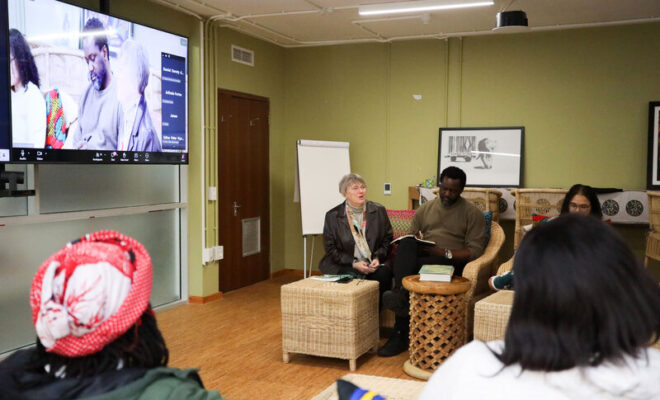
Prof Lesley Green addresses the webinar and in-person attendees.
Africa’s long-term economic future will be shaped not by its mineral wealth or fossil fuel reserves, but by its ability to unlock the full potential of its agricultural sector. That was the central message from leading academics, policymakers and agricultural experts who gathered at a recent environmental symposium focused on the future of African agriculture and soil management.
The discussions highlighted the importance of placing healthy soils, sustainable farming and local knowledge at the centre of agricultural development as the continent works to improve food security, create employment and build resilience against climate change.
Speakers argued that Africa possesses one of its greatest competitive advantages in its vast agricultural resources. Rather than relying solely on the extraction of natural resources, countries should invest in productive farming systems capable of supporting economic growth, industrial development and rural livelihoods.
Healthy soil was identified as the foundation of sustainable agriculture. Experts noted that improving soil health increases crop productivity, enhances water retention, supports biodiversity and reduces dependence on costly external inputs. As climate pressures intensify across many parts of Africa, protecting soil resources is becoming increasingly important for maintaining stable food production.
The conference also highlighted the enduring contributions of African agricultural engineer and independence leader Amílcar Cabral, whose work decades ago emphasised the close relationship between agriculture, ecology and rural development. Long before concepts such as climate-smart agriculture and sustainable farming became widely recognised, Cabral advocated for agricultural systems that respected local environmental conditions while improving the livelihoods of farming communities.
Participants stressed that successful agricultural transformation requires more than technological innovation alone. Productivity depends on the interaction between sound agronomic practices, supportive institutions, environmental stewardship and the practical knowledge developed by farmers over generations.
Growing concern was also expressed about Africa’s continued reliance on imported agricultural inputs. Researchers encouraged greater investment in locally developed soil science, research institutions and farming solutions that reflect the continent’s diverse environmental conditions instead of applying uniform approaches developed elsewhere.
Farmer participation was identified as essential to future agricultural success. Rather than viewing farmers simply as recipients of new technologies, experts argued they should be recognised as partners in agricultural innovation whose experience can help shape more effective and sustainable farming systems.
Another key priority is attracting younger generations into agriculture. As Africa’s population continues to expand, creating opportunities for young entrepreneurs in farming, agribusiness and food production will be critical to strengthening food security while reducing unemployment.
The discussions also reinforced the growing importance of agroecology, conservation agriculture and climate-smart farming practices that improve productivity while protecting natural resources. These approaches can help farmers increase yields, reduce production risks and adapt to increasingly unpredictable weather patterns.
As governments across Africa continue investing in agricultural development, experts believe the continent has an opportunity to build a more resilient and productive food system by combining scientific research, indigenous knowledge and sustainable land management. With the right policies and long-term investment, agriculture can become one of Africa’s strongest drivers of economic growth, job creation and food security for generations to come.
Brandon Moss is the Editor of AgriFocus Africa, where he leads editorial coverage on African agriculture, agribusiness, food security, and rural development. With a strong focus on market intelligence, policy analysis, and industry trends, he oversees content that connects producers, investors, and decision-makers across the continent’s agricultural value chain.