

UM6P Launches Digital Farming School in Côte d’Ivoire with OCP Africa Support
Available in

Mohammed VI Polytechnic University (UM6P) and Côte d’Ivoire’s National Polytechnic Institute Félix Houphouët-Boigny (INP-HB) have inaugurated a Digital Farming School in Yamoussoukro, aiming to develop a new generation of African professionals equipped to apply digital technology to agricultural challenges.
Launched on October 31 with support from OCP Africa and contributions from the LEET Initiative, the Digital Farming School (DFS) will welcome its first intake of 50 students on November 9. The institution attracted approximately 4,000 applications during its initial recruitment campaign.
The two-year programme is designed to bridge the gap between agricultural knowledge and digital innovation. Students will learn to identify practical challenges facing farmers and develop technology-based solutions suited to local conditions, combining agricultural sciences, computer programming and entrepreneurship.

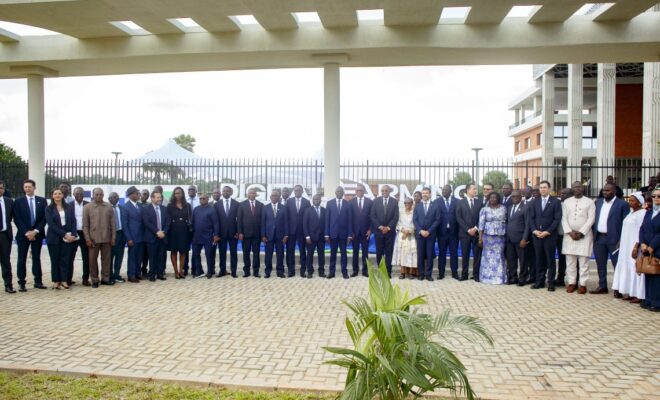
The inauguration was attended by Côte d’Ivoire’s ministers responsible for higher education, agriculture and digital transition. The ceremony was presided over by Higher Education and Scientific Research Minister Adama Diawara, alongside Agriculture, Rural Development and Food Production Minister Bruno Nabagné Koné and Digital Transition and Technological Innovation Minister Djibril Ouattara.
UM6P President Hicham El Habti said Africa must invest in knowledge and technical expertise to unlock its agricultural potential. He noted that the continent holds nearly 60% of the world’s uncultivated arable land, arguing that stronger local capabilities are essential to translating this resource into economic value.
170-hectare farm to support practical training
A key feature of the school is its 170-hectare experimental farm, which will give students an opportunity to test their ideas in real agricultural conditions.
Training projects will focus on applications such as drone-assisted field mapping, soil analysis, water management and digital monitoring of farmland. Students will be expected to take projects from identifying a specific agricultural need through to designing and testing a technological solution.
The programme will also incorporate entrepreneurship training and access to incubation support, helping students assess the commercial potential of their ideas and develop solutions that can serve farmers and agricultural businesses.
Companies and other agricultural stakeholders are expected to contribute to the curriculum by identifying market requirements and proposing projects based on challenges across agricultural value chains.
INP-HB Director General Moussa Abdoul Kader Diaby said the school demonstrates the value of cooperation between institutions with complementary expertise, built on trust and a shared commitment to development.
Strengthening Morocco-Côte d’Ivoire cooperation
The Digital Farming School builds on cooperation established in 2023 between the Ivorian government and OCP Group. It also deepens academic and scientific ties between UM6P and INP-HB, which have previously collaborated on initiatives to strengthen research and technical expertise in Côte d’Ivoire.
In February, the partners inaugurated the Green Energy Park Morocco-Côte d’Ivoire in Yamoussoukro. Like the new school, the facility forms part of broader efforts to develop local capacity in research, training and technological innovation.
The initiatives reflect a cooperation model that connects universities and industry with national development priorities. For agriculture, the next challenge will be translating the skills developed at the school into practical, commercially sustainable solutions that address farmers’ needs.
The first cohort begins classes on November 9, marking the start of a programme intended to bring digital expertise closer to the realities of African agriculture.


