

African Agricultural Institutions Seek to Sustain Gains of Seven-year CAADP-XP4 Programme
Available in

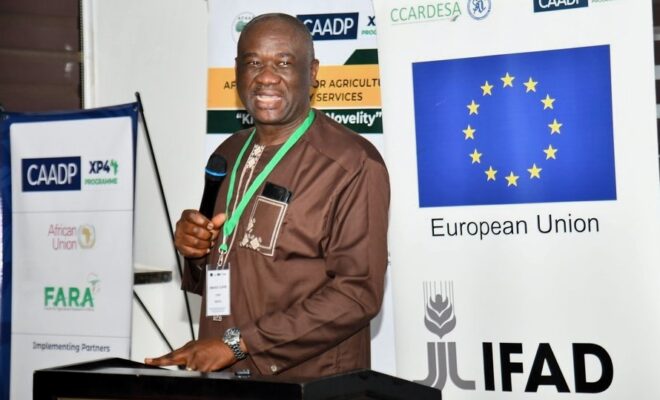
Dr Emmanue Njukwe, Director of Research and Innovation at CORAF
African agricultural research and extension organisations are developing strategies to sustain and expand agricultural innovations introduced under the seven-year Comprehensive Africa Agriculture Development Programme ex-Pillar 4 (CAADP-XP4), which reached more than 12,000 farmers across the continent.
The programme officially ended on 30 September 2026 after supporting agricultural technology development, strengthening regional research institutions and improving the exchange of innovations between African countries.

Its achievements and sustainability plans were discussed at a workshop in Nairobi, where representatives of participating organisations met to prepare the programme’s final technical and financial report and explore ways to build on its results.
Funded by the European Union (EU) under the DeSIRA initiative and administered by the International Fund for Agricultural Development (IFAD), CAADP-XP4 was established to strengthen agricultural science, technology and extension systems to improve food security and climate resilience.
The programme brought together five regional and continental organisations: the Forum for Agricultural Research in Africa (FARA), the African Forum for Agricultural Advisory Services (AFAAS), the Association for Strengthening Agricultural Research in Eastern and Central Africa (ASARECA), the Centre for Coordination of Agricultural Research and Development for Southern Africa (CCARDESA), and the West and Central African Council for Agricultural Research and Development (CORAF).
ASARECA Executive Director Dr Sylvester Dixon Baguma said the programme had strengthened institutional capacity and helped participating organisations mobilise additional resources for agricultural research.
Initially planned for four years, the programme was extended to seven years and enabled the institutions to mobilise approximately €4.08 million for additional Agricultural Innovation Research and Technology projects under AIRTEA.
Baguma highlighted the promotion of technologies designed to reduce livestock feed costs and address environmental challenges. These included Black Soldier Fly (BSF) technology, which converts organic waste into larvae that can be used as animal feed, as well as Azolla as an alternative feed resource.
In Tanzania, the technology attracted interest from the Municipal Council of Songea, which explored using municipal waste to produce BSF larvae for livestock feeding.
Other interventions included training farmers to manage banana bacterial wilt and supporting efforts to control invasive weeds, including Kariba weed.
Agricultural technology transfer strengthens regional cooperation
CAADP-XP4 also supported the transfer of agricultural innovations between countries. Baguma cited the introduction of four heat-tolerant wheat varieties from Sudan to Cameroon, where all four varieties were reportedly performing well.
The programme reached farmers through its regional organisations, with Baguma estimating that at least 3,000 farmers had benefited through each of the four regional institutions. Beneficiaries included men, women and young people who received support through agricultural technologies and training.
He said participating organisations were now developing an exit strategy, including proposals for a follow-on project to expand the adoption of successful innovations.
Climate change and the anticipated effects of El Niño are expected to feature prominently in future interventions. Baguma said eight countries within ASARECA’s regional coverage were expected to face serious climate shocks, increasing the need for resilience-building support.
FARA Executive Director Dr Aggrey Agumya said the programme had strengthened agricultural research, innovation and extension institutions, helping them translate research and policy into practical solutions for farmers.
He added that participating organisations had begun preparing for the programme’s closure two and a half years in advance by developing new projects and initiatives to sustain its achievements.
Farmer-led extension and youth innovation
AFAAS Executive Director Lilian Lihasi said CAADP-XP4 had strengthened the role of farmer leaders in delivering agricultural information and advisory services.
Through country fora bringing together farmer organisations, research institutions, private-sector players and other stakeholders, the programme supported farmers to share knowledge and demonstrate innovations within their communities.
Lihasi said farmers often learned effectively from one another, making farmer-led knowledge sharing an important part of agricultural extension.
The programme also supported digital advisory services, youth participation in extension delivery and private-sector involvement in agricultural advisory services. Lihasi said some young beneficiaries had developed businesses and created employment opportunities for others.
She pointed to the African Extension Coalition as an example of efforts to coordinate expertise and resources across the continent to improve agricultural advisory services.
Seed access and youth skills development in West and Central Africa
In West and Central Africa, CAADP-XP4 supported seed policy harmonisation, women’s participation in seed production and specialised agricultural training for young people.
CORAF Director of Research and Innovation Dr Emmanue Njukwe said the programme had helped harmonise seed policies through the Economic Community of West African States (ECOWAS), improving farmers’ access to quality improved seeds.
It also supported ROCAFES, a network of women involved in seed production across West and Central Africa. While the initiative helped women generate income through seed production, access to land and other productive resources remained a challenge.
The programme further supported 11 National Centres of Specialisation, comprising 10 commodity-based centres and one bio-risk management centre. Training covered aquaculture, livestock, rice, fruit and vegetable production, maize, mangrove rice, and root and tuber crops.
CORAF also engaged financial partners and enterprises to explore ways of improving access to affordable agricultural finance, with high borrowing costs identified as a barrier to investment in production and processing.
Climate-smart agriculture gains in Southern Africa
In Southern Africa, CAADP-XP4 supported climate-smart agriculture, institutional governance, policy dialogue and agricultural knowledge management.
CCARDESA Acting Executive Director and Head of Mission Dagmore Tawonezvi said the programme had helped farmers improve their resilience to dry conditions, particularly through solar-powered irrigation for smallholder agriculture.
The interventions enabled farmers to grow different crops, diversify their diets and extend production beyond traditional rain-fed growing periods.
The programme also strengthened CCARDESA’s governance and corporate management systems through the development of a governance manual and training for its institutional structures.
Tawonezvi said continued investment in climate-smart agriculture was essential as parts of the region faced temperatures of around 40°C and increasingly erratic rainfall. He called for further support to expand irrigation and strengthen food security, suggesting that extending implementation by another two or three years could help scale up the interventions.
As CAADP-XP4 concludes, participating institutions are seeking to build on its research capacity, technology transfer, farmer-led innovation and extension networks through new partnerships and resource mobilisation.
The proposed next phase will focus on expanding agricultural technologies and advisory services while addressing climate change, food production challenges and farmers’ access to innovations.


