
Nigeria Partners Valmont to Build Irrigation Equipment Factory, Targets 500,000 Hectares by 2030
Available in

Nigeria has partnered with US irrigation equipment manufacturer Valmont Industries to establish a domestic irrigation equipment factory as the government steps up efforts to expand mechanised farming and reduce dependence on imported agricultural technology.
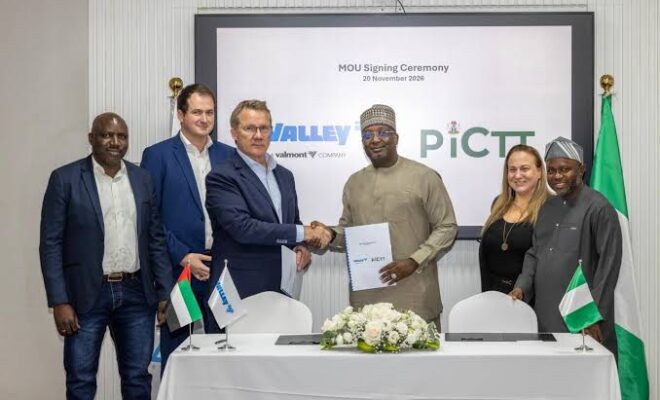
The memorandum of understanding (MoU), signed on November 22, brings Valmont’s Valley Irrigation brand into Nigeria’s Irrigate Nigeria Programme. The proposed manufacturing facility will be developed in partnership with the National Agency for Science and Engineering Infrastructure (NASENI).
The agreement also includes a planned 40,000-hectare irrigation pilot in Adamawa State, supporting Nigeria’s ambition to expand its irrigated farmland to 500,000 hectares by 2030.

Valmont partnership to boost local irrigation manufacturing
The agreement was signed by Dahiru Muhammed, Chairman of Nigeria’s Presidential Implementation Committee on Technology Transfer (PICTT), and Kalle Autto, Valmont’s Regional Vice-President for the Middle East and Africa.
The partnership aims to strengthen local manufacturing, facilitate technology transfer and develop Nigerian expertise in mechanised irrigation systems.
By establishing domestic production capacity, Nigeria hopes to improve access to irrigation equipment while reducing reliance on imported systems.
However, the partners have not yet disclosed the proposed factory’s location, investment value, production capacity or construction timeline.
Nigeria plans 40,000-hectare irrigation pilot
A key component of the agreement is a planned 40,000-hectare irrigation programme in Adamawa State.
The initiative will involve collaboration with the Nigeria Incentive-Based Risk Sharing System for Agricultural Lending (NIRSAL) and the National Agricultural Development Fund (NADF).
The pilot is expected to test mechanised irrigation infrastructure at scale and provide a foundation for potential expansion under the national irrigation programme.
Nigeria aims to increase its irrigated farmland to 500,000 hectares by 2030. According to the Food and Agriculture Organization (FAO), approximately 331,150 hectares were equipped for irrigation in 2023.
Achieving the national target will require substantial investment in irrigation infrastructure, equipment, financing and water management.
Valmont brings African irrigation experience
Valmont Industries supplies mechanised irrigation systems through its Valley Irrigation brand, specialising in centre-pivot technology used in commercial agriculture.
The company already has an established African presence, including a manufacturing and distribution facility in Nigel, Gauteng, South Africa, which has operated since 1999.
Its regional experience includes a US$172 million agreement signed with Zimbabwe in 2024 to supply centre-pivot irrigation systems covering 23,000 hectares.
In Sudan, Valmont partnered with Zadna International on agricultural irrigation projects involving 1,450 centre-pivot systems, technical training and maintenance support.
This experience could support Nigeria’s efforts to develop local technical capacity and expand mechanised irrigation.
World Bank-backed irrigation projects support expansion
The Valmont agreement comes as Nigeria advances other investments in agricultural water infrastructure.
The government has initiated contractor prequalification for rehabilitation and modernisation works at six irrigation schemes under the Sustainable Power and Irrigation for Nigeria (SPIN) project.
Supported by US$500 million in World Bank financing, the programme aims to improve water resource management, dam safety and irrigation infrastructure.
Implementation will determine Nigeria’s 2030 irrigation target
The proposed factory and Adamawa irrigation pilot could strengthen Nigeria’s agricultural production capacity by improving access to equipment, technical expertise and modern water management systems.
However, implementation will depend on investment commitments, manufacturing capacity, reliable water supplies, agricultural financing and long-term maintenance arrangements.
The next steps include finalising the factory’s investment requirements, production plans and implementation schedule, alongside preparations for the Adamawa pilot.
For Nigeria, the success of the Valmont partnership will ultimately depend on turning the agreement into locally manufactured irrigation equipment and operational farmland irrigation systems that support the country’s 500,000-hectare target by 2030.


