
Africa’s Agri-Food Sector: The Untapped Engine for Mass Employment

Available in

Africa is facing a demographic surge that will bring over 20 million new jobseekers into the labor market every year until 2050. Yet historically, the region has only managed to create around 9 million jobs annually. This gap poses a serious risk of rising unemployment, poverty, unrest, and migration pressures. Among all economic sectors, the agri-food industry stands out as the most promising solution to this challenge.
The agri-food sector already employs more than 60% of Africa’s workforce, with 45% in on-farm activities such as crop production, livestock, forestry, and aquaculture, and another 16% in off-farm roles like food processing, trading, and services. While the share of on-farm employment has declined over time, the absolute number of agricultural jobs continues to grow due to population expansion. Meanwhile, off-farm employment has surged, driven by urbanization and rising demand for processed foods.
Three key trends are accelerating job creation in this sector. First, African countries are increasingly substituting imported food with locally produced and processed alternatives. Nigeria, for example, is replacing U.S. wheat imports with domestic cultivation, while countries like Ivory Coast, Ghana, and Kenya are emerging as agricultural export leaders. Second, food demand is booming across the continent, fueled by demographic growth, urban lifestyles, and a rising middle class. Third, the African Continental Free Trade Area (AfCFTA) is improving conditions for intra-African trade, with projections suggesting a 60% expansion in agri-food trade by 2045.

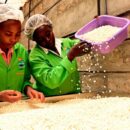
Despite rising food imports, Africa’s food exports have also grown significantly, tripling since 2000. Companies like Dangote Industries are helping close the trade gap by investing heavily in local processing. Dangote has built major facilities for tomato paste, rice, sugar, and fertilizer, creating thousands of jobs and supporting smallholder farmers. Similar success stories are unfolding in Kenya, where macadamia nut processing plants now employ thousands of workers and source from tens of thousands of farmers.
However, the continent still loses much of its value-added potential to external markets. As Kenya’s Ambassador Bitange Ndemo points out, Africa often exports raw materials while others profit from processing, branding, and distribution. In Kenya’s leather industry, for instance, only 2% of hides are fully processed locally, leaving most of the value to be captured abroad.
To reverse this trend, African agri-food value chains must be redesigned to retain more value on the continent. This means investing in infrastructure, promoting local ownership, and building stronger branding and distribution systems. Companies like Dangote are already showing how this can be done, and their model offers a blueprint for creating more high-value jobs across Africa.