

Nigeria Moves to Expand Agricultural Finance Through Non-Interest Funding
Available in

Nigeria’s National Agricultural Development Fund (NADF) has begun validating a proposed Non-Interest Finance Framework and Guidelines aimed at expanding access to funding for farmers, agribusinesses and other participants across the agricultural value chain.
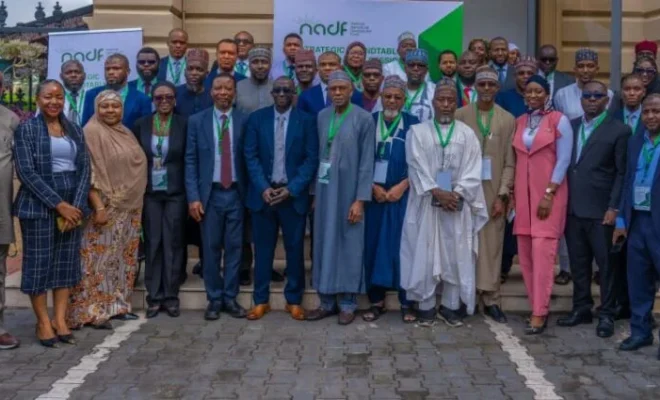
The proposed framework was discussed at a strategic roundtable and validation session in Abuja, where stakeholders examined how non-interest financing could be incorporated into NADF’s agricultural finance activities.
NADF Executive Secretary Mohammed Ibrahim said the initiative forms part of efforts to broaden the range of financing options available to Nigeria’s agricultural sector and support the Federal Government’s food security objectives.

According to Ibrahim, non-interest finance can provide alternative funding models based on asset-backed transactions and risk sharing, complementing conventional financing mechanisms.
“Our objective is not simply to introduce another financing framework,” Ibrahim said, explaining that NADF wants to broaden the financing ecosystem so that credible financing options are available to farmers, agribusinesses and other value-chain participants.
The proposed framework would establish a structured basis for delivering agricultural interventions through licensed Non-Interest Financial Institutions, while setting out governance, operational and Shari’ah compliance requirements.
NADF Head of Investment Olalekan Alabi said the framework and accompanying guidelines would provide the institutional and operational structure for the organisation’s planned non-interest financing activities.
The framework would address areas including governance, institutional responsibilities, financing structures, risk management, compliance and internal controls. The guidelines would then translate these principles into procedures for individual financing interventions.
The proposed system is expected to provide greater clarity on how financing applications and interventions are assessed, approved, implemented, monitored and reported.
Alabi said the validation process was intended to determine whether the proposed arrangements were technically robust and practical to implement. Stakeholders were asked to identify gaps, inconsistencies, overlaps and areas requiring further clarification before the documents are finalised.
For farmers and agricultural businesses, the potential significance lies in expanding the number of financing structures available beyond conventional interest-based lending. Access to suitable finance remains an important challenge across many parts of Nigeria’s agricultural value chain, particularly for production, infrastructure, mechanisation and other capital-intensive activities.
Dr Paul Oluikpe, Director of the Development Finance Advisory Department of the Central Bank of Nigeria (CBN), said substantial work was still required to improve agricultural finance in the country.
Oluikpe said the scale of Nigeria’s financing needs was significant given the size of the population, the importance of agriculture to the economy and the challenges affecting different stages of the value chain.
He welcomed the proposed framework and encouraged NADF to draw on specialists in non-interest finance and other relevant stakeholders during the development process.
Prof. Bashir Umar, Deputy Chairman of the CBN’s Financial Regulation Advisory Council of Experts, said the initiative was consistent with broader efforts to promote financial inclusion and expand access to formal financing.
He said non-interest financing could complement existing mechanisms and help mobilise additional resources for agriculture, particularly for Nigerians who may not currently participate fully in formal financial systems.
The validation process brings together stakeholders from financial institutions, regulators, development finance institutions and academia. Their input is expected to help NADF refine the proposed framework before its finalisation.
For Nigeria’s farmers and agribusinesses, the immediate development is not a new financing facility that is already available, but the creation of a proposed framework that could eventually support additional financing channels.
If successfully implemented, such mechanisms could give agricultural businesses more options for financing production, processing, infrastructure and other activities across the value chain.
However, the effectiveness of the system will ultimately depend on how accessible the financing becomes in practice, the terms offered to agricultural businesses, the risk-management mechanisms used by participating institutions and the ability of farmers and agribusinesses to meet the relevant requirements.
As NADF continues the validation process, the focus will therefore be on turning the proposed framework into a practical financing mechanism capable of reaching agricultural businesses beyond Nigeria’s major commercial centres and supporting investment across the wider food and farming value chain.