

Tanzania and Norway Strengthen Partnership to Boost Agricultural Investment and Trade
Available in

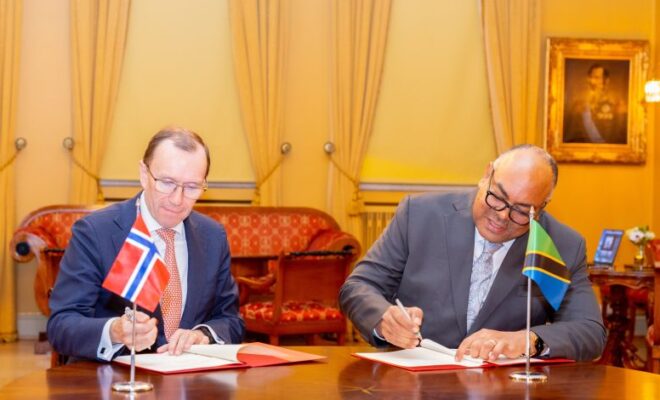
Minister for Foreign Affairs and East African Cooperation, Ambassador Mahmoud Thabit Kombo (right) and Norway’s Foreign Affairs Minister, Espen Barth Eide, sign a joint declaration to expand trade and economic cooperation in Oslo, Norway, recently.
Tanzania and Norway are strengthening economic cooperation through a new agreement aimed at expanding trade, attracting investment and supporting industrial development, with agriculture, energy, manufacturing and renewable energy identified as key areas of opportunity.
The commitment was reinforced during the fourth round of Tanzania-Norway Political Consultations held in Oslo on 18 November 2026, where the two countries signed a Joint Declaration to expand trade and economic cooperation.

Tanzania’s Minister for Foreign Affairs and East African Cooperation, Ambassador Mahmoud Thabit Kombo, and Norway’s Foreign Affairs Minister, Espen Barth Eide, co-chaired the consultations and participated in the signing ceremony.
The agreement provides a framework for increasing private-sector participation, strengthening commercial partnerships, encouraging technology transfer and creating employment opportunities.
For Tanzania, the renewed cooperation supports its National Development Vision 2050, which identifies investment, industrialisation, productivity and private-sector growth as important drivers of long-term economic development.
Agriculture offers opportunities for investment and technology transfer
Agriculture is among the sectors expected to benefit from stronger Tanzania-Norway relations, particularly through investment in agricultural productivity, processing, storage and value-chain development.
One existing initiative is a three-year project worth 15 million Norwegian kroner, launched in February 2025 through cooperation involving Norway and the Alliance for a Green Revolution in Africa (AGRA).
The programme supports Tanzania’s agricultural transformation agenda, with a focus on agricultural investment, strengthening small and medium-sized enterprises and creating opportunities for farmers, women and young people.
Norwegian agricultural company Yara Tanzania also has an established presence in the country’s fertiliser industry, including investment in a fertiliser terminal at the Port of Dar es Salaam.
These partnerships demonstrate opportunities for international expertise and investment to support access to agricultural inputs and strengthen commercial farming.
Further cooperation could help Tanzania expand local agricultural processing, improve storage infrastructure, develop irrigation systems and increase access to international markets.
Increasing the processing of agricultural commodities locally would enable the country to retain more value from production rather than depending heavily on exports of unprocessed products. This could also create employment, improve farmers’ incomes and strengthen agricultural export earnings.
Energy and renewable investment support industrial growth
Energy remains another important area of cooperation, particularly as Tanzania seeks to develop its natural gas resources and strengthen its position in regional and international energy markets.
Norwegian company Equinor has operated in Tanzania since 2007, when it signed a Production Sharing Agreement with the Tanzania Petroleum Development Corporation (TPDC) for offshore Block 2.
Equinor operates the block with a 65% participating interest, alongside ExxonMobil, which holds 35%. TPDC has the right to participate with a 10% interest.
Exploration has resulted in nine gas discoveries, with estimated resources exceeding 20 trillion cubic feet of gas in place.
These discoveries provide a foundation for discussions around the proposed Tanzania Liquefied Natural Gas (LNG) project, which could generate foreign exchange, government revenue and employment while creating opportunities for local engineering, construction, transport and supply businesses.
Renewable energy is also an important part of the partnership. In July 2026, the Royal Norwegian Embassy and TaTEDO-SESO signed a three-year grant agreement worth 30 million Norwegian kroner to support Tanzania’s green energy and clean cooking transition.
The initiative is expected to support renewable energy enterprises, expand clean energy technologies and promote environmentally sustainable economic activities.
Reliable and affordable electricity is particularly important for agricultural processing and manufacturing businesses seeking to improve productivity and control operating costs.
Blue economy and digital technology offer further opportunities
The renewed cooperation also creates opportunities in the blue economy, fisheries, aquaculture, digital technology and climate financing.
Norway’s experience in marine resource management and fish processing could support Tanzania in improving fisheries production, storage, product quality and export capacity.
Digital technology partnerships could also encourage innovation, improve business efficiency and create opportunities for technology-based enterprises, particularly those established by young Tanzanians.
Trade imbalance highlights export opportunities
Despite the longstanding relationship, trade between the two countries remains uneven.
According to Tanzania’s National Bureau of Statistics Statistical Abstract 2025, imports from Norway amounted to TSh23.402 billion in 2025, while Tanzania’s domestic exports to Norway totalled TSh617 million.
The difference highlights opportunities for Tanzania to strengthen its export capacity and improve access to the Norwegian market.
Agricultural producers and manufacturers could benefit from stronger business connections, investment in processing and improved product quality to meet international market requirements.
Beyond trade and investment, the partnership is expected to support human capital development through technical training, research collaboration and the transfer of industrial expertise.
The renewed engagement builds on more than six decades of diplomatic relations between Tanzania and Norway, formally established in 1964. Their cooperation dates back to before Tanzania’s independence, when Norwegian teachers, doctors, nurses and engineers contributed to development initiatives in the country.
The latest agreement provides an opportunity to extend that relationship into new commercial partnerships, with agriculture, energy and industrial development forming important parts of Tanzania’s economic transformation agenda.