

NADF Launches Blended Finance Initiative to Unlock Agricultural Investment in Nigeria
Available in

The National Agricultural Development Fund (NADF) has unveiled a new blended finance initiative designed to attract greater private sector investment into Nigeria’s agricultural sector by reducing investment risks and improving access to capital for agribusinesses.
The initiative forms part of broader efforts to strengthen agricultural financing, boost food production and accelerate economic growth through increased investment in one of Nigeria’s most strategic sectors.
New Strategy Targets Agricultural Funding Gap

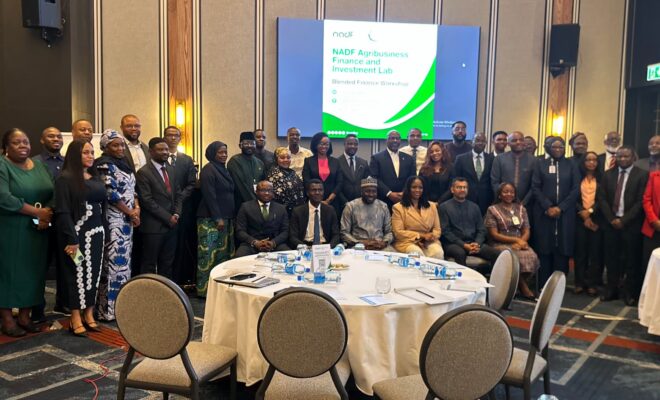
The blended finance programme was officially launched during a workshop for fund managers organised by NADF in collaboration with Convergence Blended Finance, a global network focused on mobilising private capital into emerging and developing markets.
The initiative seeks to address one of the biggest challenges facing Nigeria’s agricultural sector — limited access to affordable financing.
By combining public, development and private capital, the programme aims to create investment structures that reduce risk while attracting commercial investors into agriculture and agribusiness projects.
Agriculture Critical to Nigeria’s Economy
Speaking during the workshop, NADF Chief Executive Officer Mohammed Ibrahim emphasized the strategic importance of agriculture to Nigeria’s future development.
Represented by the General Manager of Partnerships and Investor Relations, Nasir Ingawa, Ibrahim described agriculture as a cornerstone of food security, employment creation, industrial development, export growth and economic prosperity.
He noted that the scale of investment required to transform Nigeria’s agricultural sector far exceeds the financial capacity of government alone.
According to him, attracting private investment will be essential to achieving long-term agricultural growth and modernization.
NADF Positioned as Investment Catalyst
Ibrahim explained that NADF intends to play a central role in connecting investors with viable agribusiness opportunities across the country.
The fund will work to identify bankable projects, facilitate partnerships and support the development of investment structures capable of attracting commercial financing.
“NADF is positioning itself as a catalyst within the agricultural finance ecosystem by connecting investors with credible agribusiness opportunities and helping to structure investments that can attract commercial funding,” he said.
The organisation also plans to serve as a convening platform that brings together capital providers, technical experts, guarantee institutions and agribusiness operators.
By coordinating these stakeholders, NADF hopes to strengthen the agricultural investment landscape and increase funding flows into productive sectors of the economy.
Blended Finance Seen as Key Investment Tool
Also speaking at the event, Head of Africa at Convergence Blended Finance, Aakif Merchant, highlighted the significant role agriculture plays within Nigeria’s economy.
He noted that agriculture contributes approximately 30 percent of the country’s Gross Domestic Product and accounts for around 35 percent of national employment.
Despite its economic importance, the sector continues to face difficulties attracting sufficient private investment due to concerns about risk.
Merchant said blended finance offers an effective solution by combining development funding with commercial capital to make agricultural investments more attractive to investors.
Pension Funds Present New Opportunity
One of the major opportunities identified during the workshop is the growing potential for institutional investment in agriculture.
Merchant pointed to recent regulatory changes allowing pension funds to allocate up to 10 percent of their portfolios to alternative investments.
The policy shift could unlock significant pools of long-term capital that may be directed toward agricultural development projects.
According to Merchant, blended finance structures can help channel these resources into agriculture by improving risk-sharing arrangements and enhancing investment returns.
Addressing Investor Concerns
Industry experts at the workshop identified several factors that continue to discourage investment in Nigeria’s agricultural sector.
These include currency volatility, high transaction costs, limited project scale and broader concerns about investment risk.
Merchant stressed the importance of aggregating viable investment opportunities and building stronger agricultural value chains capable of generating sustainable returns.
He argued that successful blended finance transactions must balance three key objectives: development impact, investor returns and financial leverage.
Opportunities in Import Substitution
The initiative also seeks to support Nigeria’s efforts to reduce dependence on agricultural imports while strengthening domestic production.
Merchant highlighted sectors such as palm oil and fish production as areas where Nigeria has significant untapped potential.
Despite being historically associated with palm oil production, Nigeria continues to import substantial quantities of the commodity.
Similarly, fish imports remain high despite the country’s extensive coastline and abundant natural resources.
Expanding domestic production in these sectors could help conserve foreign exchange, create jobs and strengthen food security while generating attractive investment opportunities.
Supporting Food Security and Economic Growth
The launch of the blended finance initiative comes at a time when Nigeria is seeking innovative solutions to address food security challenges, increase agricultural productivity and stimulate economic growth.
Stakeholders believe greater private sector participation will be essential to achieving these goals, particularly as public resources remain constrained.
By leveraging development capital to attract commercial investment, the programme aims to unlock billions of naira in funding that could transform agricultural value chains and improve access to finance for farmers and agribusinesses.
Strengthening Nigeria’s Agricultural Future
As Nigeria continues to pursue agricultural transformation, the NADF blended finance initiative represents a significant step toward building a more sustainable and investment-friendly agricultural sector.
With stronger collaboration between government, development institutions, investors and agribusiness operators, the initiative has the potential to accelerate agricultural growth, create employment opportunities and enhance the sector’s contribution to national development.
Industry observers say the success of the programme could serve as a model for future agricultural financing initiatives across Africa, helping to bridge funding gaps and unlock the continent’s vast agricultural potential.


