

Cassava Gains Momentum as Kenya Looks to Strengthen Food Security and Rural Economies
Available in

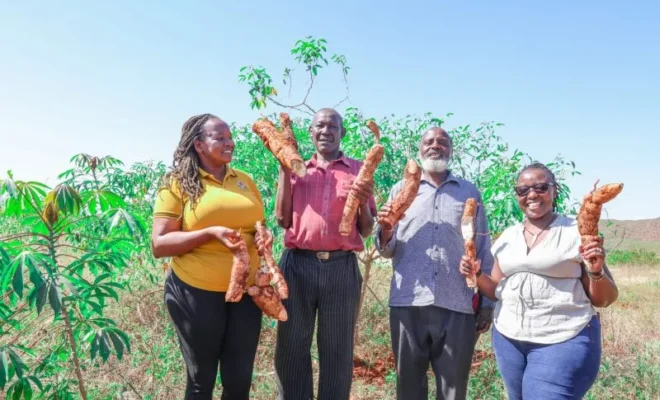
Cassava is rapidly emerging as one of Kenya’s most promising agricultural crops as the country seeks solutions to climate change, food insecurity and rising unemployment, particularly among young people.
Long regarded as a subsistence crop, cassava is now attracting growing attention from researchers, policymakers and agribusiness stakeholders for its potential to improve household food security, generate rural incomes and supply raw materials to a range of industries.
Kenya currently produces around 1.2 million metric tonnes of cassava each year, well below national demand of nearly three million metric tonnes. The production shortfall has left the country dependent on imports from neighbouring Uganda and Tanzania, highlighting significant opportunities to expand domestic cultivation.

According to Professor Richard Mulwa, Cassava Value Chain Lead under the TAGDev 2.0 Programme at Egerton University, increasing local production could unlock new opportunities for farmers, processors and investors while reducing Kenya’s reliance on imported cassava products.
The TAGDev 2.0 Programme is promoting cassava as a climate-smart commercial crop by supporting research, improving access to drought-tolerant varieties and providing training in sustainable farming practices, post-harvest management and value addition.
Mulwa said integrating scientific research with farmer training and enterprise development is helping rural communities adapt to changing climatic conditions while creating more sustainable sources of income.
Smallholder farmer Thomas Maina from Njoro in Nakuru County said adopting improved cassava production techniques has significantly increased his harvests after years of struggling with declining maize yields.
He explained that the training introduced better cultivation methods and improved planting material, allowing his family to produce enough cassava for household consumption while generating additional income from surplus production.
The crop has also created new business opportunities within his family. Fresh cassava is now supplied to markets in Samburu County, while locally processed cassava flour is being used to manufacture baked products and other value-added foods.
Beyond primary production, cassava offers opportunities across the agricultural value chain, including seed multiplication, aggregation, transport, processing, packaging, branding and marketing. The crop also supports a wide range of industries through its starch, which is used in livestock feed, pharmaceuticals, paper manufacturing, textiles, adhesives, biodegradable packaging and bioethanol production.
Mulwa said wider adoption of high-quality cassava flour could help reduce Kenya’s dependence on imported wheat by partially replacing wheat in bakery products and enhancing maize and cereal flour blends.
The TAGDev 2.0 Programme has already supported more than 4,400 farmers, demonstrating the role that research institutions can play in strengthening agricultural productivity and rural livelihoods.
With continued investment in research, innovation and value chain development, stakeholders believe cassava could become an increasingly important contributor to Kenya’s food security, job creation and long-term agricultural growth.